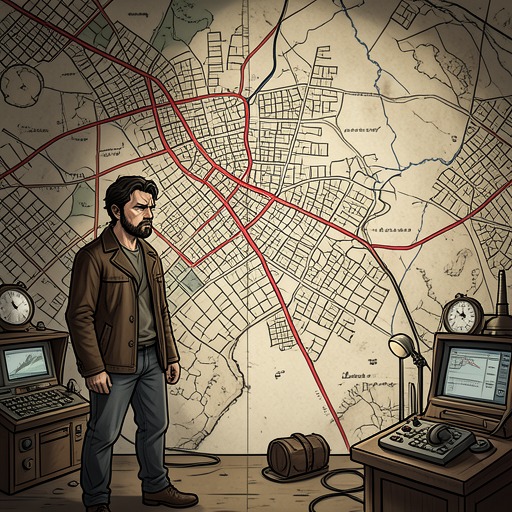
Black Belt poverty and overcrowding
Native SonBlack Belt poverty and overcrowding in Native Son are consequences of a racial order that confines Black residents to restricted areas of Chicago while extracting profit from their housing and labor. The novel makes this condition concrete in the Thomas family’s one-room home, then places it within a larger system of housing, education, and employment limits. In Max’s courtroom argument, the cramped room is not an incidental hardship: it is evidence of how private property and public rules shape the lives available to Bigger Thomas and his family.
Spatial confinement and housing
The Thomas family pays eight dollars a week for a single unventilated, rat-infested room in which four people eat and sleep. The details give overcrowding an immediate material scale: the issue is not simply that the family is poor, but that the housing available to it offers little space or basic comfort at a rent Max describes as exorbitant. During the hearing, he challenges Mr. Dalton over the disparity between rents charged to Black and white families for comparable houses. Dalton first disclaims responsibility for setting rent scales and invokes supply and demand; Max’s questions instead direct attention to the arrangements that determine who can rent where and at what price.
The limits extend beyond the quality and cost of a room. Mr. Dalton acknowledges that he refuses to rent houses to Black people in other parts of the city. Max connects that exclusion to the operation of the Dalton Real Estate Company: its policy helps keep Black residents together in one area on the South Side. Dalton says he did not originate the practice, but acknowledges that it works that way. The result is a housing boundary maintained through ordinary business decisions rather than presented as a single, exceptional act. For the Thomas family, residence in the Black Belt is part of a larger confinement that restricts access to neighborhoods elsewhere in Chicago.
Rent, profit, and philanthropy
The novel sets the Dalton family’s wealth and charitable giving against the rent collected from the Thomas family. Max asks why Mr. Dalton, who donates millions of dollars to educate Black people, charges the family so much for its inadequate room. He then questions whether the profits extracted through rent are effectively returned as charity, easing the consequences without changing the source of the hardship. Dalton rejects Max’s characterization, and the coroner objects to the questioning; the exchange nevertheless exposes the tension between public generosity and private economic practice.
Max’s later argument sharpens that tension. He describes the relationship between the Thomas and Dalton families as one of renter to landlord, customer to merchant, and employee to employer: the Thomas family becomes poorer while the Dalton family becomes richer. Mr. Dalton is portrayed as a decent man who tries to respond to social wrong through giving, but Max insists that donations cannot substitute for changing the conditions that produce deprivation. The critique is not that charity has no value; it is that charity leaves intact the housing restrictions and unequal relations from which the benefactor also benefits.
Deprivation beyond the home
The courtroom argument situates housing within a broader pattern of limited opportunity. Max says that Black people are told where to live, how much schooling they may receive, where they may eat, and what kinds of work they may do. He emphasizes the break between school and adult life: Bigger has been taught what white children are taught, yet encounters a world in which their paths diverge and his ability to act on his ambitions is restricted. Education can raise expectations without removing the barriers that govern employment and daily life.
A man held in a cell gives a parallel, agitated account of conditions on the South Side. He alleges that residents are crowded together, that stale food is sold in the Black Belt, that hospitals are not built despite taxation, that schools are overcrowded, and that Black workers are hired last and fired first. The scene presents these claims as an outburst from a distressed prisoner, not as a neutral statistical report. Its force lies in the accumulation of grievances, which echoes Max’s argument that deprivation is distributed across housing, food, health care, schooling, and work rather than confined to the home.
Public crisis and structural meaning
The novel also shows how the Black Belt is treated when Mary Dalton’s remains are discovered. Newspaper accounts report a police cordon of five thousand officers, more than three thousand volunteers, searches of Black homes under a blanket warrant, and the dismissal of Black employees across the city. These events do not explain the origins of overcrowding, but they show the community facing intensive surveillance and collective suspicion at the moment its housing conditions and social position become part of a public crisis. The Black Belt appears both as a place where residents are confined and as a territory subjected to exceptional scrutiny.
Max asks the court to understand Bigger’s life as shaped by conditions created collectively, rather than to treat poverty or crime as detached from their social setting. He points to housing restrictions, limited schooling, and barriers to work, while also noting that Black and white people remain separated even inside the courtroom. His argument presents Black Chicagoans as a population held within the nation but denied equal political, social, economic, and property rights. Black Belt poverty and overcrowding thus carry a significance beyond domestic hardship: they reveal how spatial segregation, unequal rents, constrained opportunity, and charitable paternalism can reinforce one another while preserving the appearance of individual goodwill.